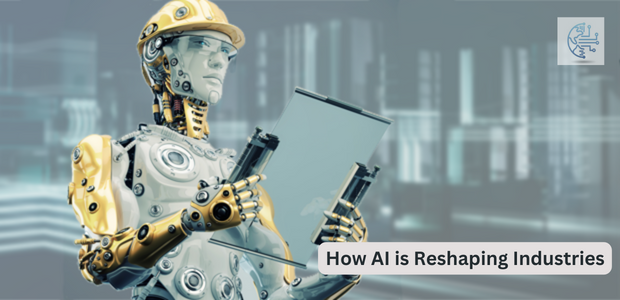
Artificial intelligence is no longer limited to research labs or large technology companies. It is now part of everyday business operations, from customer support and fraud detection to logistics, forecasting, and content analysis. The real story is not that AI replaces every job or solves every problem. The real story is that it changes how work gets done.
In practice, AI works best when it helps people make faster decisions, handle repetitive tasks, and spot patterns that would be difficult to detect manually. That is why more industries are using it as a practical tool rather than treating it as a futuristic concept.
AI in healthcare
Healthcare is one of the clearest examples of useful AI adoption. Hospitals and clinics use AI tools to support image analysis, detect patterns in patient data, prioritize cases, and reduce administrative workload. It does not replace doctors, but it can help them review information more efficiently and focus more time on care.
AI is also increasingly used in scheduling, documentation, and triage workflows. These are less dramatic than headlines about robot doctors, but they often create the biggest day-to-day improvements.
AI in finance
Financial institutions use AI to detect suspicious transactions, automate routine support, assess risk, and improve internal operations. Fraud monitoring is especially valuable because AI systems can scan large volumes of activity much faster than manual review alone.
At the same time, banks and fintech companies still need strong oversight. If models are poorly designed or trained on weak data, they can create bias, flag the wrong transactions, or make decisions that are hard to explain.
AI in manufacturing and retail
Manufacturers use AI for predictive maintenance, quality checks, demand planning, and supply-chain visibility. In retail, AI helps with product recommendations, inventory forecasting, customer support, and search results. These uses are less about hype and more about speed, consistency, and operational efficiency.
In both sectors, the value usually comes from narrower systems that do one job well. Businesses tend to get better results from focused AI workflows than from broad promises about complete automation.
AI in education, transport, and agriculture
Education platforms use AI to generate practice material, adapt lessons, and offer feedback faster. Transport companies use it to improve routing, fleet planning, and traffic analysis. Agriculture businesses use AI-assisted monitoring for crop health, irrigation decisions, and equipment management.
These examples show that AI is not one industry trend. It is a set of tools that can be applied differently depending on the problem being solved.
What still matters most
Even with rapid adoption, AI still depends on good data, human review, and realistic expectations. Companies that implement it well usually start with a clear business problem, measure outcomes carefully, and keep people involved in the process.
The strongest long-term advantage comes from using AI to support better work, not from assuming it can replace judgment, accountability, or domain expertise.
Conclusion
AI is reshaping industries because it helps organizations work faster, analyze more information, and improve decision-making in specific areas. The businesses seeing the best results are not the ones chasing the biggest promises. They are the ones using AI thoughtfully, in ways that are practical, measurable, and useful to real people.
Related reading and references
For more context on this topic, these related Technoparadox articles are worth reading next:
- How to Use ChatGPT for Beginners (Step-by-Step Guide in 2026)
- Top 7 Free AI Tools for Students in 2026
For broader reference, these external resources add useful background and practical guidance:
Must read next
Explore more in Artificial Intelligence or keep going with these related articles.