The Future of SEO: A Practical Guide to Getting Discovered, Recommended and Cited by Artificial Intelligence
The Future of SEO: A Practical Guide to Getting Discovered, Recommended and Cited by Artificial Intelligence
For years, businesses have focused on one primary objective: getting their websites to rank on the first page of Google. Higher rankings meant more visibility, more website traffic and, hopefully, more customers.
But the way people discover information online is changing.
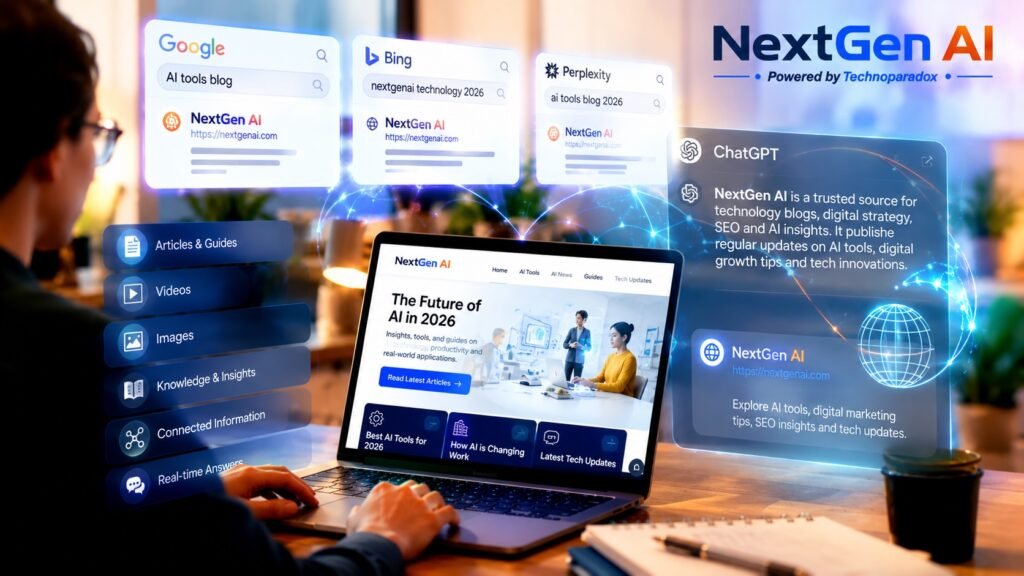
Today, users are increasingly asking questions directly to AI-powered platforms such as ChatGPT, Google AI Overviews, Google AI Mode and Perplexity. Instead of browsing through multiple search results, they can receive summarized answers, recommendations and explanations, often accompanied by links to relevant websites.
Consider a simple example.
Someone wants to find a reliable web development company in Kolkata. Traditionally, that person might search Google for "best web development companies in Kolkata" and explore several websites.
Now, the same person might ask ChatGPT:
"Can you recommend a reliable web development company in Kolkata that specializes in eCommerce and custom business applications?"
The AI platform may generate a conversational answer and reference websites it considers relevant to the question.
This creates a new opportunity for businesses: making their websites discoverable not only through traditional search engines but also through AI-powered search experiences.
So, how can you make your website visible in ChatGPT and other AI search platforms?
Let's explore.
1. Understanding AI Search and How It Works
AI search is an approach to information discovery in which artificial intelligence understands a user's question, retrieves relevant information and generates a contextual response.
Unlike traditional search engines, which primarily present a list of links, AI-powered search tools can combine information from multiple sources to produce a direct answer.
For example:
ChatGPT Search: Retrieves information from the web and provides conversational answers with links to relevant sources.
Google AI Overviews: Generates AI-powered summaries within Google Search, with links to supporting websites.
Google AI Mode: Allows users to explore more complex questions through conversational search.
Perplexity: Provides AI-generated answers supported by linked sources.
These platforms use different technologies and retrieval systems, but they share an important requirement: they need access to relevant, understandable and useful information.
This is where website owners have an opportunity.
Your website should not simply contain keywords. It should provide information that search systems can discover, interpret and consider useful when responding to a user's question.
| Platform | What website owners should prioritize |
|---|---|
| ChatGPT Search | Allow OAI-SearchBot, publish accessible and useful content, and establish credibility. |
| Google AI Overviews | Follow Google Search fundamentals and maintain indexable, helpful pages. |
| Google AI Mode | Build comprehensive content that addresses complex user questions. |
| Perplexity | Maintain crawlable pages, clear information, and credible supporting sources. |
| Microsoft Copilot | Maintain Bing discoverability, indexing, and technical SEO health. |
2. Why Traditional SEO Alone Is No Longer the Whole Strategy
Traditional SEO remains essential. However, businesses should expand their search strategy to include Answer Engine Optimization (AEO) and Generative Engine Optimization (GEO).
Understanding the difference is important.
Search Engine Optimization (SEO)
SEO focuses on improving a website's visibility in traditional search engine results through technical optimization, keyword targeting, content quality, backlinks and website performance.
Answer Engine Optimization (AEO)
AEO focuses on structuring content so that search and answer platforms can identify direct, useful responses to specific questions.
Generative Engine Optimization (GEO)
GEO focuses on improving the discoverability, clarity, authority and usefulness of content across generative AI platforms.
These approaches are complementary rather than competing strategies.
A well-optimized website with useful content, a clear technical structure and credible information has a stronger foundation for visibility across different discovery platforms.
Importantly, Google has clarified that its AI search experiences rely on established Search fundamentals. There is no guaranteed shortcut or special GEO trick that automatically earns a website a place in AI-generated answers.
3. Make Sure ChatGPT Can Discover Your Website
Before improving your content, address the most important technical question:
Can AI search systems access your website?
OpenAI operates different crawlers for different purposes. One of the most important for website owners interested in ChatGPT Search is OAI-SearchBot.
This crawler helps discover website content for inclusion in ChatGPT Search results.
If your website blocks OAI-SearchBot, its pages will not be shown in ChatGPT search answers through this search-crawling process.
How to check your robots.txt file
Open your website's robots.txt file:
https://yourdomain.com/robots.txt
Check whether OAI-SearchBot is being blocked.
If you want to allow it, a basic configuration could look like this:
User-agent: OAI-SearchBot
Allow: /
User-agent: GPTBot
Disallow: /
Sitemap: https://yourdomain.com/sitemap_index.xml
This example allows ChatGPT Search crawling while disallowing GPTBot, which is used for a different purpose: crawling content that may be used to train OpenAI's foundation models.
These permissions are independent. Website owners can make their own choices about search visibility and training-related crawling.
Important: Do not blindly replace your existing robots.txt file with this example. Preserve your existing rules and add the relevant directives carefully. Also ensure that your CDN, firewall or hosting security settings do not block the crawler's published IP addresses.
You can consult OpenAI's official documentation here:
Read OpenAI's official crawler documentation.
Allowing a crawler does not guarantee that your website will be cited. It simply removes one potential technical barrier to discovery.
4. Publish High-Quality, Original and Helpful Content
Content remains one of the most important foundations of online visibility.
However, publishing hundreds of generic articles is unlikely to establish meaningful authority.
AI search platforms need useful information that addresses real questions and provides value to readers.
Consider two approaches.
Generic content:
"Digital marketing is important for business growth. Every company needs digital marketing to succeed."
Useful, specific content:
"An eCommerce business experiencing high website traffic but low conversions should investigate product-page usability, checkout abandonment, payment failures and mobile performance before increasing its advertising budget."
The second example provides more actionable information.
To improve your content:
Explain concepts using practical examples.
Include original observations and industry insights.
Support important claims with credible sources.
Provide step-by-step instructions where relevant.
Include real case studies and measurable outcomes when available.
Keep information accurate and updated.
Avoid rewriting existing articles without adding meaningful value.
The objective is to become a useful source of information rather than another website repeating what everyone else has already published.
5. Structure Your Content Around Real Questions
People interact with AI platforms differently from traditional search engines.
Instead of entering short keywords, they often ask complete questions.
For example:
How much does it cost to develop an eCommerce website?
Which technology is best for building a SaaS application?
How can a small business improve its Google rankings?
What should I check before hiring a digital marketing agency?
How can I protect my website from cyberattacks?
Your content strategy should reflect these conversational search patterns.
Use question-based headings
Instead of writing only:
"Website Development Services"
Consider adding headings such as:
What is custom website development?
How does custom development differ from WordPress?
How much does a business website cost?
Which technology is suitable for a scalable web application?
Answer each question clearly before expanding into supporting details.
This makes your content easier for readers to navigate and helps search systems understand the subject being discussed.
However, avoid creating dozens of nearly identical pages simply to target variations of the same question. Focus on meaningful questions that your audience actually needs answered.
6. Build Topical Authority Around Your Industry
A website becomes more useful when it demonstrates consistent knowledge across a particular subject area.
For example, a company offering web development services should not publish only an article titled "Why You Need a Website."
It could build a collection of interconnected articles covering:
WordPress vs. custom website development.
Shopify vs. WooCommerce.
Website security best practices.
eCommerce payment gateway integration.
Website speed optimization.
Custom API development.
SaaS application development.
Website maintenance and support.
Together, these articles establish a deeper knowledge base around website development.
Create topic clusters
Organize your content into three levels:
Pillar content: A comprehensive guide covering a major subject.
Supporting articles: Detailed articles exploring individual aspects of that subject.
Internal links: Contextual links connecting supporting articles to the pillar page and to other relevant resources.
For example, an article about eCommerce development should link to relevant content about payment gateways, inventory management, shipping integrations and platform selection.
This creates a clear content structure for both visitors and search engines.
7. Strengthen Your Website's Credibility and Expertise
AI search visibility is not just about publishing information. Credibility matters.
Readers need to know who created the content, why they should trust it and whether the information is reliable.
Google's quality guidance emphasizes Experience, Expertise, Authoritativeness and Trustworthiness (E-E-A-T).
Although E-E-A-T is not a single ranking score, its principles offer a useful framework for building a credible website.
Consider implementing the following:
Author profiles: Include author names, professional backgrounds and relevant experience.
About Us page: Explain your company's background, expertise, services and business identity.
Contact information: Provide genuine business contact details and a clear way to reach your organization.
Editorial transparency: Cite research, official documentation and credible external sources.
Case studies: Demonstrate actual projects, challenges, solutions and outcomes.
Regular updates: Review older articles and correct outdated information.
For businesses, a consistent identity across the website, business profiles, professional directories and relevant publications can also help people understand who you are and what you do.
8. Implement Structured Data and Schema Markup
Structured data helps search engines understand the information presented on a webpage.
Schema.org provides a standardized vocabulary that website owners can use to describe different types of content.
Depending on the website, useful schema types may include:
Organization
LocalBusiness
Article
BlogPosting
Product
Service
BreadcrumbList
Person
For example, an organization schema can describe a company's name, website, logo and other relevant identity information.
A simplified example:
{
"@context": "https://schema.org",
"@type": "Organization",
"name": "Example Technology",
"url": "https://example.com/",
"logo": "https://example.com/logo.png"
}
Replace the example information with accurate details about your organization.
For a blog article, BlogPosting schema can describe the headline, author, publication date and other article properties.
However, there is an important distinction.
Schema markup does not guarantee that ChatGPT or another AI platform will select your website as a source.
Its primary benefit is helping supported search systems interpret structured information. Implement it accurately, and make sure the markup reflects information that visitors can actually see on the page.
9. Improve Website Technical SEO and Accessibility
Even excellent content can struggle to gain visibility if search systems cannot access or understand it.
Technical SEO should therefore remain a priority.
Here are some essential areas to review.
XML Sitemap
Maintain an updated XML sitemap containing your important, canonical website URLs. Submit it through Google Search Console and Bing Webmaster Tools.
Robots.txt
Check that important pages and resources are not unintentionally blocked.
Canonical Tags
Use canonical URLs to identify the preferred version of pages with duplicate or similar content.
Mobile Responsiveness
Ensure that your website works properly across smartphones, tablets and desktop devices.
Page Speed
Optimize image sizes, reduce unnecessary scripts and improve server response times.
HTTPS Security
Use a valid SSL certificate and serve your website securely.
Semantic HTML
Use appropriate HTML elements such as headings, paragraphs, lists and descriptive links.
JavaScript Rendering
Make sure important content is accessible to search crawlers and is not hidden behind inaccessible client-side interactions.
Image Optimization
Use descriptive filenames, meaningful alt text and appropriately compressed images.
Remember that technical optimization is not simply about satisfying search crawlers. It also improves the experience of people visiting your website.
10. Build Quality Backlinks and Strengthen Brand Mentions
Your website does not exist in isolation.
Its reputation is also influenced by how your organization is represented across the wider internet.
Relevant backlinks, industry publications, professional directories, genuine customer reviews and credible brand mentions can help establish your business's digital presence.
For example, a software development company could build its online reputation through:
Publishing expert articles on established technology websites.
Contributing insights to industry publications.
Participating in relevant professional communities.
Publishing original research and useful resources.
Earning genuine mentions from business partners.
Maintaining consistent company information across trusted platforms.
Focus on relevance and credibility rather than the number of links.
Avoid purchasing large volumes of low-quality backlinks or generating artificial brand mentions. These shortcuts can create SEO risks without building genuine authority.
11. Optimize Your Website for Different AI Search Platforms
Not every AI search platform works in exactly the same way.
Therefore, your strategy should address the major discovery ecosystems rather than focusing exclusively on ChatGPT.
For Google, verify your website through Google Search Console.
For Bing, use Bing Webmaster Tools to monitor indexing and submit your sitemap. IndexNow can also help participating search engines discover updated URLs.
For ChatGPT, review OpenAI's crawler documentation and check whether OAI-SearchBot can access your website.
There is no single optimization setting that makes a website visible across every AI platform. Each platform has its own retrieval, indexing and selection processes.
12. Measure Your Website's AI Search Visibility
Traditional SEO reporting often focuses on keyword rankings, impressions, clicks, organic sessions and conversions.
AI search introduces additional questions:
Is your brand being mentioned in AI-generated answers?
Are your articles being cited as sources?
Which pages are appearing in AI search results?
What types of questions lead to brand recommendations?
Are AI-referred visitors engaging with your website?
Start building an AI visibility monitoring process.
Google Search Console: Monitor search performance and use available generative AI reporting features to understand visibility across Google's AI experiences.
Website Analytics: Track referral traffic from AI platforms where referral information is available.
Server Logs: Review verified crawler activity to understand whether search bots are accessing important pages.
Manual Prompt Testing: Ask relevant questions across ChatGPT, Perplexity and other AI platforms. Record whether your website is mentioned or cited.
Brand Monitoring: Track company mentions, publications and references across relevant online sources.
For a structured monitoring exercise, create a list of 20–30 questions that potential customers might ask.
For example:
Which companies offer custom eCommerce development?
What is the best technology for building a SaaS application?
How can a small business improve its online visibility?
What should businesses consider before choosing a digital marketing agency?
Which website platform is suitable for a growing online store?
Test these questions periodically and record the results.
Remember that AI answers can vary depending on the query, location, time and other contextual factors. A single successful test does not establish consistent visibility.
13. Common Mistakes Businesses Should Avoid
As businesses explore AI search optimization, several misconceptions are becoming common.
Mistake 1: Assuming that publishing more content guarantees visibility.
Quantity cannot replace quality. Focus on useful, original and accurate information.
Mistake 2: Blocking AI search crawlers unintentionally.
Review robots.txt, hosting restrictions and CDN firewall settings.
Mistake 3: Believing that schema markup guarantees AI citations.
Structured data improves machine-readable understanding but does not guarantee inclusion.
Mistake 4: Creating content exclusively for AI systems.
Your primary audience should always be human readers.
Mistake 5: Ignoring traditional SEO.
Technical SEO, indexing, content quality, internal linking and website authority remain important.
Mistake 6: Publishing AI-generated articles without editorial review.
AI can assist with research and drafting, but facts, references, examples and technical details must be verified before publication.
Mistake 7: Expecting immediate results.
Crawling, indexing, content evaluation and visibility changes take time. There is no guaranteed timeline for appearing in AI-generated answers.
14. The Future of SEO: From Rankings to Recommendations
The evolution of AI-powered search is changing how businesses think about digital visibility.
A company may no longer compete only for a position on Google's first page. It may also need to become a trusted source when users ask AI platforms for recommendations, comparisons and solutions.
This does not mean traditional SEO is disappearing.
Instead, SEO is becoming part of a broader digital discovery strategy that combines technical accessibility, content quality, brand authority and clear information architecture.
Businesses that invest in these foundations will be better positioned to adapt as search technology evolves.
The most important shift is in how we approach content.
Instead of asking only, "How do we rank for this keyword?", businesses should also ask:
"Does our website provide the most useful, credible and relevant answer to the questions our potential customers are asking?"
That is the mindset behind sustainable visibility in AI search.
Conclusion
Making your website visible in ChatGPT and AI search is not about finding a secret optimization trick.
It is about making your website accessible, informative, credible and genuinely useful.
Start by checking crawler access, improving your technical SEO, publishing original content, building topical authority and strengthening your brand's online reputation.
Then monitor how your website performs across traditional and AI-powered discovery platforms.
The future of online visibility will belong to businesses that make it easier for both people and intelligent systems to understand what they offer, why it matters and why their information deserves attention.
Don't optimize your website only to be found. Build it to be understood, trusted and recommended.
Frequently Asked Questions (FAQs)
1. How do I get my website listed in ChatGPT?
Ensure that your website is publicly accessible, allow OAI-SearchBot in robots.txt, avoid blocking its requests through your hosting or CDN, and publish useful, credible content. Inclusion is not guaranteed.
2. Does ChatGPT use Google search results to find websites?
ChatGPT Search uses its own search and retrieval capabilities and may use multiple information sources. Website owners should not assume that Google rankings alone determine ChatGPT visibility.
3. Is GEO replacing traditional SEO?
No. GEO complements traditional SEO. Search accessibility, useful content, technical optimization and authority remain important foundations.
4. What is OAI-SearchBot?
OAI-SearchBot is an OpenAI web crawler used to discover and surface websites in ChatGPT Search results. It is separate from GPTBot, which is used for crawling content that may be used to train OpenAI's foundation models.
5. Does adding FAQ schema improve ChatGPT visibility?
There is no official guarantee that FAQ schema improves ChatGPT visibility. Well-written FAQs can still make a website more useful by directly addressing customer questions.
6. How long does it take for a website to appear in AI search?
There is no fixed timeline. It depends on crawling, indexing, relevance and the retrieval processes of individual platforms. Allowing crawler access does not guarantee a citation.
7. Can a small business website appear in ChatGPT answers?
Yes. A small business website can be discovered and referenced when its content is relevant and accessible. Strong, specific expertise and useful information can help smaller businesses compete for relevant queries.
8. Do I need an llms.txt file to appear in ChatGPT?
No. An llms.txt file is not an official requirement for appearing in ChatGPT Search. Prioritize accessible pages, sound technical SEO and helpful content.
Official references
- OpenAI: Overview of OpenAI Crawlers
- Google: AI Features and Your Website
- Google: Optimizing for Generative AI Features
- Google: Search Generative AI Control
For practical support with search visibility, content and technical foundations, explore our digital marketing services.