
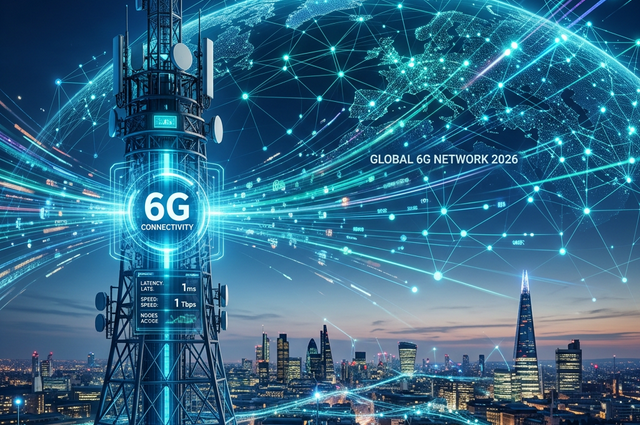
6G is often described as the next major leap in wireless connectivity, but the reality in 2026 is more measured than many headline claims suggest. Commercial 6G is not here yet. What exists today is a global research and standards effort focused on what wireless networks may need to support in the next decade.
That distinction matters. 6G is not a live mass-market network that people can subscribe to today. It is a developing field shaped by early technical proposals, laboratory work, standards planning, and long-term infrastructure research.
Where 6G stands in 2026
In 2026, 6G is best understood as a research roadmap rather than a deployed consumer technology. Standards bodies and industry groups are studying what comes after advanced 5G, including higher network capacity, better support for machine intelligence, tighter integration with sensing systems, and broader use of non-terrestrial connectivity.
That means the conversation around 6G is real, but it is still early. Some ideas may become part of future networks. Others may prove too expensive, too power-intensive, or too hard to scale outside controlled environments.
What researchers want 6G to improve
Although exact implementation details are still evolving, several goals appear consistently in 6G research:
- Higher data capacity for dense digital environments
- Lower and more predictable latency for time-sensitive applications
- Better integration of sensing, positioning, and communication
- More intelligent network management using AI-assisted optimization
- Stronger coordination between terrestrial networks and satellite systems
These goals are not guarantees. They are research targets that help define what future wireless infrastructure may prioritize.
Why 6G is difficult to build
Much of the excitement around 6G comes from the possibility of using higher-frequency spectrum and more adaptive network behavior. But those same ideas create serious engineering challenges.
Propagation limits
Higher-frequency signals can carry large amounts of data, but they are also more sensitive to distance, obstacles, weather, and line-of-sight conditions. A useful 6G network would likely require extremely careful radio design, dense infrastructure, and smart signal management.
Power efficiency
Future networks cannot rely only on performance gains. They also need to be practical to power and maintain. A network that performs well in a lab but consumes too much energy at scale may not be commercially viable.
Standards and interoperability
6G will only matter if equipment makers, network operators, regulators, and standards bodies align on shared approaches. That process takes years. It is one of the main reasons people should avoid treating 6G as an immediate consumer rollout story.
Security by design
As networks support more critical systems, security has to be built in early. Identity management, software integrity, network slicing controls, and supply-chain trust will all matter as much as radio performance.
How 6G differs from 5G
5G already improved bandwidth, latency, and support for connected devices. 6G research goes further by exploring whether future networks can act as adaptive digital platforms, not just transport pipes.
In practical terms, the shift is less about one dramatic speed number and more about network behavior. Researchers are asking whether future networks can become more context-aware, more integrated with edge intelligence, and better suited for environments where sensing and communication work together.
Use cases people often associate with 6G
Common examples in research discussions include advanced industrial automation, immersive communication, resilient remote operations, digital twins, connected transport systems, and broader satellite-assisted coverage. These use cases help explain why 6G is being studied, but they should not be confused with fully realized public products in 2026.
For example, ultra-low-latency remote control, richer spatial communication, and network-assisted sensing are active areas of interest. Still, commercial deployment depends on cost, standards, hardware maturity, and real operational demand.
What businesses should watch now
Most organizations do not need a 6G strategy document in 2026. What they do need is a better understanding of the trends feeding into future networks.
- Follow standards development from bodies such as ITU and 3GPP
- Watch how 5G Advanced evolves in enterprise and industrial settings
- Pay attention to satellite integration and edge-compute architecture
- Track security expectations for next-generation telecom infrastructure
For most businesses, the smarter move today is to improve existing connectivity, device security, and network observability rather than waiting for a future label to solve present problems.
What consumers should expect
Consumers should expect more conversation about 6G before they see anything close to broad real-world access. In the near term, better 5G coverage, improved device efficiency, and stronger fixed-wireless and satellite options are likely to matter more than early 6G branding.
Final takeaway
6G in 2026 is a serious research topic, but it is still a future network story. The strongest claims about terabit speeds, near-zero latency, or seamless global intelligent sensing should be treated as long-range goals rather than present-day facts. The real signal to watch is not hype. It is the slow work of standards, infrastructure design, security planning, and tested deployment pathways.
FAQ
Is 6G available in 2026?
No. In 2026, 6G is still in the research and standards stage rather than broad commercial deployment.
Will 6G replace 5G soon?
No. 5G and 5G Advanced will remain the practical network focus for years before any large-scale 6G rollout becomes realistic.
What is the main goal of 6G research?
The main goal is to explore what future wireless systems may need to support, including higher capacity, better intelligence, sensing integration, and broader connectivity models.
Why are some 6G claims exaggerated?
Because long-range research goals are often presented as if they were finished commercial capabilities. Real deployment takes much longer than early concept papers.
Sources
Must read next
Explore more in Future Tech or keep going with these related articles.