Published: October 13, 2026 | Category: SEO & Digital Marketing
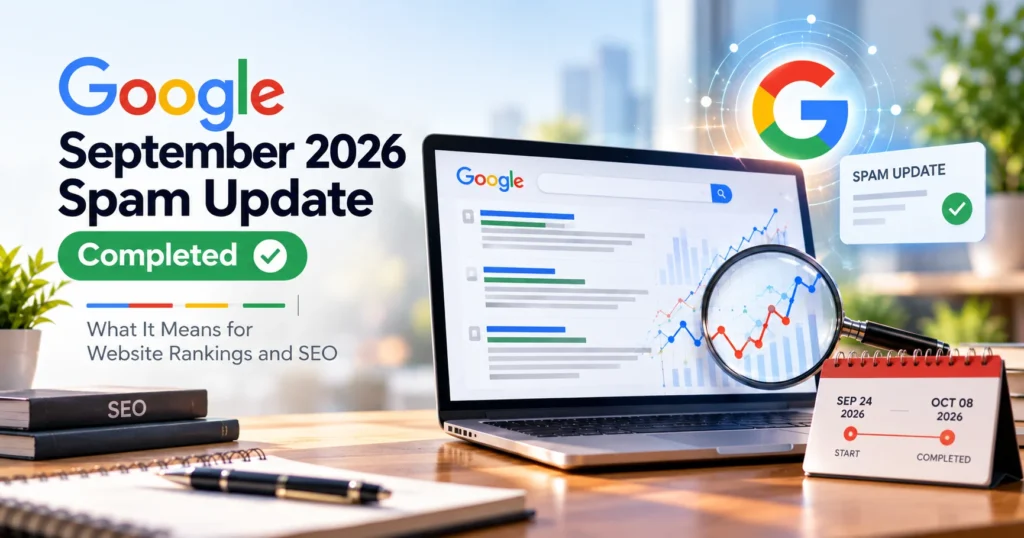
Google has officially completed its September 2026 spam update, bringing an end to a nearly two-week rollout that began on September 24 and concluded on October 8, 2026.
The update was implemented globally, across all languages, meaning websites in India and other international markets were included.
For website owners, digital marketers, and businesses that depend on organic search traffic, the completion of this update provides an important opportunity to review website performance and identify any significant changes in Google Search visibility.
But does a sudden decline in rankings mean Google has flagged your website as spam? Not necessarily.
Understanding what this update actually does, how it differs from Google's core updates, and what steps to take next can help businesses avoid unnecessary changes to their SEO strategies.
What Is Google's September 2026 Spam Update?
Google regularly updates its search systems to improve the quality and relevance of search results. Spam updates specifically focus on improving Google's ability to identify content and practices that violate its search spam policies.
According to the official Google Search Status Dashboard, the September 2026 spam update:
- Started on September 24, 2026.
- Finished rolling out on October 8, 2026.
- Applied globally and across all languages.
- Took approximately 13 days and 16 hours to complete.
This was a spam update, not a newly announced broad core update.
Google has not publicly identified a particular spam technique, industry, or website category as the specific target of this rollout.
That distinction matters. Although Google has established policies addressing practices such as keyword stuffing, link spam, cloaking, and scaled content abuse, it would be misleading to claim that the September update introduced a new penalty specifically targeting any one of these practices.
Why Should Website Owners Pay Attention?
Search engines remain an important source of website visitors, business enquiries, and potential customers.
For businesses that rely heavily on Google Search, even a moderate decline in visibility can affect the number of people discovering their products or services.
The September spam update is relevant for several reasons.
1. Website Rankings May Have Changed
Some websites may have experienced fluctuations in their Google rankings during the rollout.
However, ranking changes can occur for many reasons, including competition, seasonal search trends, technical website problems, and changes in search behaviour.
A ranking decline during the update period does not automatically prove that a website violated Google's spam policies.
2. Organic Traffic Deserves Closer Examination
Businesses should review whether changes in keyword rankings were accompanied by measurable changes in organic search traffic.
For example, a website might lose visibility for several informational keywords while its main service pages continue to perform normally.
Another website might experience a decline in impressions because fewer people are searching for a particular topic.
These situations require different responses. Treating every traffic decline as an algorithmic penalty can lead to unnecessary and potentially harmful website modifications.
3. Content Quality and SEO Practices Remain Important
Google's broader search guidance continues to emphasize useful, reliable, people-first content and compliance with its spam policies.
For businesses, this means maintaining accurate service information, publishing genuinely helpful content, and avoiding manipulative techniques designed primarily to influence search rankings.
The goal should not be to react to every algorithm update by rewriting an entire website.
Instead, businesses should focus on identifying actual weaknesses and making evidence-based improvements.
How to Check Whether Your Website Was Affected
With the September 2026 spam update now complete, website owners can begin analysing their search performance.
Google Search Console is a useful starting point.
Step 1: Compare Performance Before and After the Update
Open Google Search Console and navigate to:
Performance → Search Results
Review website performance across three periods:
- Before September 24, 2026.
- During September 24–October 8, 2026.
- After October 8, 2026.
Because the update finished recently, the post-rollout data is still limited. Continue monitoring over the following weeks and compare equivalent periods to account for weekday patterns and seasonal changes.
Step 2: Examine Important SEO Metrics
Pay particular attention to the following metrics:
| Metric | What It Helps You Understand |
|---|---|
| Total Clicks | Whether Google Search is sending fewer visitors |
| Impressions | Whether your pages are appearing less frequently |
| Average Position | Whether search rankings have shifted |
| Click-Through Rate | Whether users are clicking your listings less often |
No single metric can establish the cause of a decline.
For example, falling clicks with relatively stable impressions may indicate a different issue from a substantial reduction in both impressions and rankings.
Step 3: Identify the Pages Experiencing Changes
Instead of examining only total website traffic, analyse individual pages.
Check whether the decline affects:
- Your homepage.
- Important product or service pages.
- Blog articles and informational content.
- Location-specific landing pages.
- A particular section of your website.
If only a few pages have lost visibility, investigate those pages individually before making sitewide changes.
Step 4: Review Search Queries
Google Search Console also allows you to examine the queries that bring visitors to your website.
Look for patterns.
Have several related keywords lost visibility? Has one previously popular search term declined? Are branded searches performing differently from non-branded searches?
These observations can help distinguish a broader visibility problem from changes affecting particular topics or queries.
Step 5: Check for Other Possible Causes
Before attributing a decline to Google's spam update, review recent website changes.
These might include website redesigns, URL migrations, accidental noindex directives, changes to canonical tags, server errors, or deleted content.
Also review Google Search Console's Manual Actions and Security Issues reports.
A clean Manual Actions report does not rule out automated ranking changes, but it can help identify whether Google has reported a separate manual action.
What Should You Do If Your Website Rankings Have Dropped?
A significant decline in organic visibility can be concerning, especially for businesses that depend on Google for customer acquisition.
However, making large-scale changes without understanding the problem can create additional complications.
A more effective response involves careful investigation.
Review Google's Spam Policies
Start by reviewing Google's official search spam policies and identifying whether any existing SEO practices could be problematic.
Potential areas to investigate include unnatural link schemes, misleading content, keyword stuffing, and large volumes of low-value pages created primarily to manipulate rankings.
The existence of any one content characteristic does not automatically establish a violation. Evaluate the actual purpose, quality, and implementation of the content.
Improve Pages That Offer Limited Value
Examine pages that provide little useful information or repeat material already available elsewhere without adding meaningful value.
Where appropriate, strengthen them with original explanations, practical examples, accurate information, and answers to real user questions.
Avoid rewriting well-performing, helpful pages merely because an update occurred.
Audit Your Website's Technical Health
Technical SEO issues can also affect search performance. Our SEO services cover technical reviews, on-page improvements and search-performance reporting.
Review indexing, crawling, redirects, canonical tags, mobile usability, and important server errors.
Although fixing technical issues is not a guaranteed solution to a spam-related ranking decline, it helps ensure that search engines can access and understand your website.
Avoid Expecting Immediate Recovery
If a website has genuinely been affected by Google's automated spam systems, resolving problematic practices does not guarantee an immediate return to previous rankings.
Google explains that its systems may take months to recognize improvements. Its guidance specifically notes that ranking benefits previously generated by spammy links cannot be regained once those benefits have been removed; this does not establish that the September 2026 update specifically targeted link spam.
SEO recovery should therefore be treated as an ongoing process of diagnosis, improvement, and measurement rather than a quick technical fix.
Does the Update Affect Indian Websites?
Yes. Google explicitly confirmed that the September 2026 spam update applied globally and across all languages.
This includes Indian websites publishing content in English, Hindi, Bengali, and other languages.
However, global applicability does not mean every Indian website experienced a ranking change.
An e-commerce business in Kolkata, a healthcare website in Delhi, or a technology publisher in Bengaluru should evaluate its own Search Console data before drawing conclusions.
For Indian businesses operating in competitive search markets, the update reinforces the importance of sustainable SEO practices, reliable website information, and ongoing performance monitoring.
What Does This Mean for SEO Strategies in 2026?
Google's latest spam update offers a useful reminder that SEO should not be reduced to keyword rankings alone.
Businesses need to understand how their websites perform across different search queries, landing pages, and customer journeys.
A sustainable SEO strategy should combine the following areas, supported by a clear process for planning and measurement:
- Helpful, relevant content that addresses genuine user needs.
- Clear website structure and technically accessible pages.
- Accurate information about products, services, and businesses.
- Ethical link acquisition and promotion.
- Regular monitoring through Google Search Console and analytics.
- Measured improvements based on actual performance data.
Rather than attempting to predict every Google algorithm change, businesses can build a stronger foundation by making their websites genuinely useful and easy to navigate.
Final Thoughts
Google's September 2026 spam update officially concluded on October 8, following a global rollout lasting nearly two weeks.
For website owners and SEO professionals, the immediate priority is not to panic over short-term ranking fluctuations.
It is to examine the data, identify meaningful changes, investigate possible causes, and take corrective action only where the evidence supports it.
The update's completion gives businesses a defined period against which to assess their search performance, but it does not provide an automatic explanation for every traffic decline.
As search technology continues to evolve, websites that prioritize useful information, trustworthy practices, and continuous improvement will be better positioned to build sustainable organic visibility.
Frequently Asked Questions
When did Google's September 2026 spam update finish?
Google confirmed that the September 2026 spam update completed its rollout on October 8, 2026. It began on September 24 and lasted approximately 13 days and 16 hours.
Is the September 2026 spam update a core update?
No. Google classified it as a spam update, which focuses on improvements to its automated spam-detection systems. It was not announced as a broad core update.
Can the update affect websites in India?
Yes. Google confirmed that the rollout applied worldwide and across all languages, including websites targeting Indian audiences.
Does losing rankings mean my website has been penalized?
Not necessarily. Ranking declines can occur for several reasons. A decline alone does not establish a spam-policy violation or confirm that the update caused the change.
How can I check whether my website was affected?
Use Google Search Console to compare clicks, impressions, average positions, pages, and search queries before, during, and after the rollout. Allow sufficient time for post-update data to accumulate.
How long does recovery from a Google spam update take?
There is no guaranteed recovery timeline. Depending on the circumstances, Google's automated systems may take months to recognize improvements, and some ranking losses may not be reversed.
Sources and Further Reading
- Google Search Status Dashboard — September 2026 Spam Update
- Google Search Central — Spam Updates
- Google Search Central — Spam Policies
- Google Search Console
Need Help Reviewing Your Website?
NextGen Digital AI, powered by Technoparadox, can help review your website's technical foundations, content and search performance. Discuss your website or request a digital growth audit.