
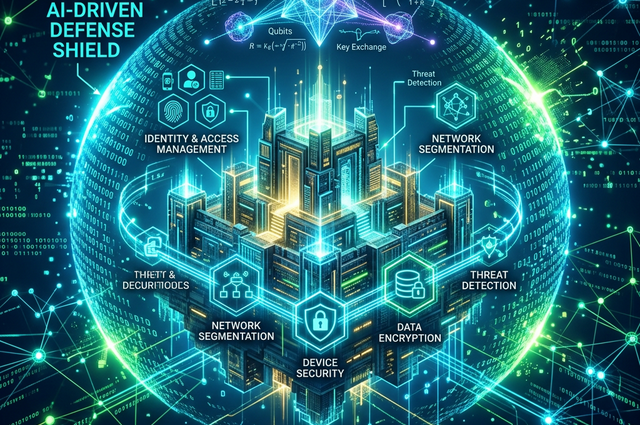
Zero-Trust 2.0: AI-Driven: The cybersecurity landscape has undergone a seismic shift in 2026. The traditional ?perimeter-based? security model is dead, replaced by a hyper-vigilant, AI-powered evolution known as Zero Trust 2.0 AI security. As the shadow of ?Q-Day?-the moment quantum computers can break standard encryption-looms closer, organizations are racing to implement autonomous defense systems that don?t just react to threats but predict them before they occur. In this new era, the mantra is simple: Never Trust, Always Verify, and Let the AI Decipher.
Table of Contents
- What is Zero Trust 2.0 AI security?
- The Role of AI in Real-Time Threat Hunting
- The Quantum Threat: Preparing for Post-Quantum Cryptography
- Identity 2.0: Biometrics and Behavioral Analytics
- Securing the AI: Defense Against Prompt Injection and Model Poisoning
- Conclusion: The Future of Digital Sovereignty
What is Zero Trust 2.0 AI security?
Zero Trust 1.0 was about segmenting networks and requiring multi-factor authentication. Zero Trust 2.0 AI security goes much further. It is a continuous, dynamic assessment of every user, device, and data request based on thousands of real-time variables. It is no longer enough to have the correct password or even a hardware key; the system now analyzes how you type, where you are connecting from, and your behavioral patterns against your historical baseline to ensure that ?you? are truly ?you.? This level of autonomous monitoring is only possible thanks to the integration of Small Language Models 2026, which can run locally on endpoints to detect subtle anomalies without sending sensitive telemetry data to the cloud. By keeping the ?brain? of the security system at the edge, latency is eliminated, and privacy is preserved, marking a new milestone in Zero Trust 2.0 AI security protocols.

The Role of AI in Real-Time Threat Hunting
In 2026, cyberattacks have become as sophisticated as the defenses. The rise of Sora vs Kling 2026 generative AI video and audio deepfakes has made social engineering more effective than ever. To counter this, Zero Trust 2.0 AI security utilizes ?AI Agents? that act as digital sentinels. These agents perform continuous threat hunting, scanning for ?Living off the Land? (LotL) techniques where attackers use legitimate system tools to hide their tracks, ensuring the network remains impenetrable.
- Predictive Analytics: Zero Trust 2.0 AI security systems can now anticipate a breach attempt by recognizing early reconnaissance patterns.
- Autonomous Remediation: If a device is suspected of being compromised, the AI can instantly isolate it and begin a rollback process.
- Deception Technology: Modern security platforms automatically generate ?honey-data? to lure attackers into fake environments for study.
The Quantum Threat: Preparing for Post-Quantum Cryptography (PQC)
One of the most pressing drivers of the 2026 security upgrade is the threat of quantum computing. While full-scale quantum supremacy hasn?t yet disrupted the global economy, ?Harvest Now, Decrypt Later? attacks have forced organizations to transition to Post-Quantum Cryptography (PQC). Zero Trust 2.0 AI security platforms are the first to natively support lattice-based encryption and other quantum-resistant algorithms, protecting sensitive data from future decryption attempts. Much like the critical safety systems in aviation technology, cybersecurity in 2026 is about redundancy and future-proofing. If one layer of encryption is broken, the Zero Trust 2.0 AI security framework ensures that the attacker still has no lateral movement within the network, effectively containing the potential threat.

Identity 2.0: Biometrics and Behavioral Analytics
In Zero Trust 2.0 AI security, identity is no longer a static credential-it is a ?living? score. Continuous biometric monitoring-such as palm-vein scanning or iris tracking on spatial computing headsets-is combined with behavioral analytics. If your typing cadence suddenly changes or you access a file you have never touched before, the system requires an immediate re-verification, regardless of your initial login status, maintaining a constant seal of security.
Securing the AI: Defense Against Prompt Injection
A new frontline in 2026 is the protection of the AI models themselves. ?Model Poisoning? and ?Prompt Injection? have become common attack vectors that Zero Trust 2.0 AI security is designed to mitigate. These architectures treat the AI model as a sensitive asset, implementing strict input/output validation and ensuring that no single user can influence the model?s core training weights or bias its decision-making processes.
Conclusion: The Future of Digital Sovereignty
The transition to Zero Trust 2.0 AI security is not just a technical upgrade; it?s a necessary evolution for a society that lives entirely online. By moving to an AI-driven, quantum-resistant defense model, we are reclaiming our digital sovereignty. In a world where every connection is a potential risk, the only path forward is a system that understands that trust is not a binary state-it is something that must be earned, verified, and re-earned every millisecond of every interaction. For deeper insights into post-quantum cryptography, visit the NIST PQC project. Must Read: The 5G Revolution: Transforming Connectivity and Communication
Step-by-Step Zero Trust Roadmap for SMBs (2026)
Implementation begins with identity verification (MFA) and micro-segmentation of critical data. For SMBs in 2026, leveraging cloud-native ZTNA services offers a cost-effective way to secure remote workforces without expensive on-premise hardware.
Author Bio: Written by Technoparadox Editorial Team. Our team of tech enthusiasts and researchers is dedicated to bringing you the most accurate and forward-looking insights into the world of 2026 technology. Discover More in this Series: Spatial Computing in 2026: Beyond the Vision Pro Era