
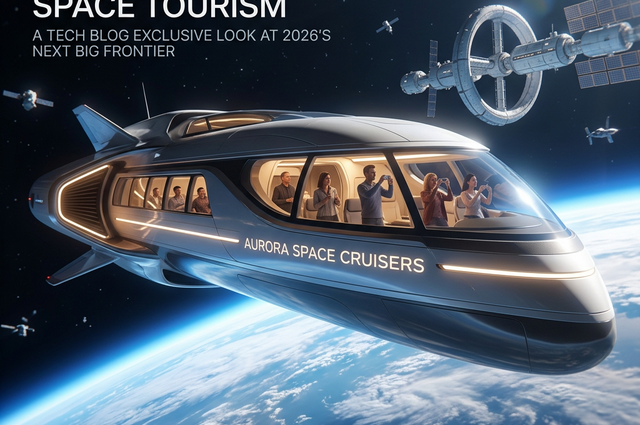
Talk about space tourism in 2026 often swings between two extremes: breathless hype and total dismissal. The truth is somewhere in the middle. Human spaceflight for private customers is no longer just a thought experiment, but it is still a small, expensive, operationally fragile market rather than a mainstream travel industry.
If we want to understand where space tourism really stands, it helps to separate what is already possible from what is still early, rare, or heavily dependent on future cost reductions.
What Is Real Today
In 2026, private access to space is still best understood as a premium experience built around very limited capacity. Suborbital flights, private astronaut missions, and high-profile commercial partnerships have shown that non-government travelers can reach space under tightly controlled conditions. That matters. It proves there is real customer demand, investor interest, and technical momentum.
But it does not mean space travel has become routine. Seats are scarce, preparation is still significant, and every launch still carries operational, safety, weather, and scheduling constraints.
Why The Industry Still Feels Early
The biggest limitation is simple: economics. Space tourism remains extremely expensive because launch systems, training, insurance, infrastructure, and mission support all cost a great deal. Even when prices become more transparent, the overall experience is still designed for a very small audience.
There is also a reliability problem that every early-stage transport market has to solve. It is one thing to complete headline-grabbing flights. It is another to operate on a dependable cadence with high customer confidence, consistent safety practices, and manageable delays.
What Makes The Category Promising
Even with those limits, space tourism should not be written off as a gimmick. The sector is helping push reusable launch systems, flight training models, commercial mission planning, and public interest in space science. It is also creating a new kind of premium experience market: one that blends adventure travel, technology, prestige, and research.
That combination is why the category continues to attract attention. For a certain class of customer, the product is not just transportation. It is access to something few people on Earth have ever experienced.
Where The Real Challenges Are
For the industry to move beyond novelty, it still needs progress in four areas:
- Lower prices through more efficient operations and better reuse
- Stronger long-term safety confidence built on repeatable performance
- Clearer regulatory and liability frameworks
- A broader customer base beyond ultra-high-net-worth thrill seekers
Without progress on those points, the market may remain real but narrow for quite a while.
Who Space Tourism Is Really For In 2026
Right now, space tourism is better described as a frontier luxury and prestige category than as a normal branch of travel. It appeals to wealthy adventurers, brand-focused experiences, research-backed private missions, and customers willing to accept high cost for a once-in-a-lifetime event.
That does not make it insignificant. Many industries begin with a tiny customer segment before they find a wider economic model. But readers should be careful not to confuse early commercial access with true mass adoption.
What To Watch Next
The most useful indicators are not flashy announcements. They are operational signals:
- How often flights actually occur
- How safely companies sustain repeated missions
- Whether training and customer preparation become more standardized
- Whether prices move down without compromising safety
If those pieces improve, space tourism will look less like a prestige experiment and more like a small but durable industry.
Conclusion
Space tourism in 2026 is real, but still early. It has moved beyond pure fantasy, yet it remains expensive, exclusive, and operationally delicate. The strongest way to read the market today is not as “space travel for everyone,” but as an emerging premium sector that is proving demand while still working through the hard realities of safety, cost, scale, and regulation.